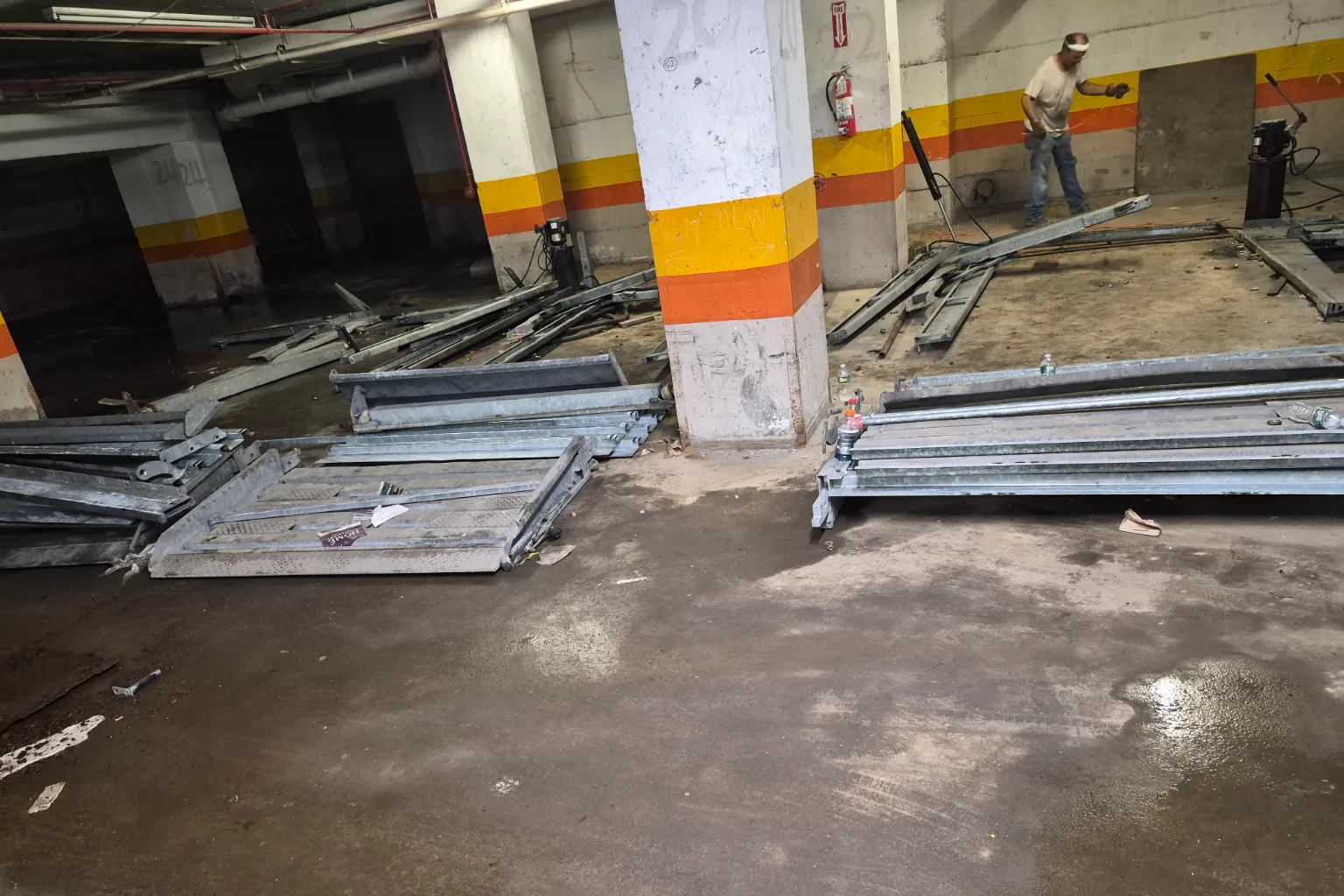
Parking Lift Removal
The Stackers Are Dead. Get Them Out, Get The Bays Back.
We dismantle and remove parking stackers, car lifts and puzzle systems from commercial garages, cut the anchors flush, make good the slab and re-stripe the bays as standard stalls. Nights and weekends, with the rest of the garage still open.
Free on-site assessment · Itemized quote · No obligation
A Lift Nobody Uses Is Costing You Every Month.
Stackers get installed to squeeze stalls out of a tight garage and then quietly stop earning. Parts stop being made, the service contract keeps renewing, tenants refuse to use them, and the bays underneath sit empty because nobody will park under a lift that sticks.
Out Of Service, Still Billed
A dead system still carries a maintenance contract, an inspection cycle and an insurance line. None of that stops until the steel leaves the building.
A Liability Sitting In A Bay
Worn cables, leaking rams and platforms that drift are a hazard the building owns. An out-of-service tag is not a fix, it is a decision waiting to be made.
Stalls You Cannot Rent
Drivers avoid a lift they do not trust, so both bays go soft. Taken out, the same footprint rents as ordinary stalls that anyone will use.
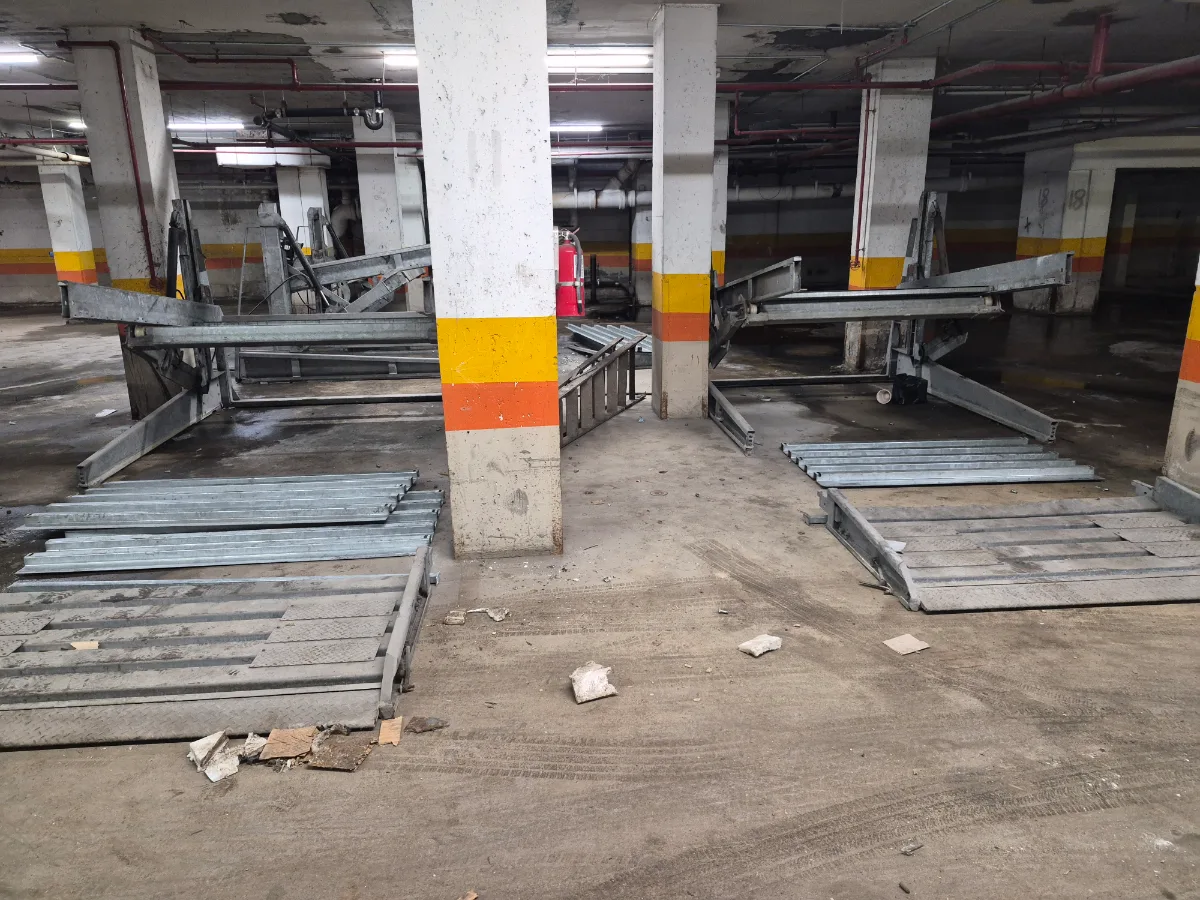
Dismantled In Place, Carried Out, Floor Made Good
No crane, no ramp closure, no dropping a platform down a level. We break the system down where it stands, carry it out in pieces sized for your freight elevator or ramp, and leave a flat bay with the anchors cut off and the stalls re-marked. Most garages keep operating around us.
Dismantled In Place
Platforms, posts, rams and cross members cut and unbolted in the bay, in pieces a low-clearance garage can actually get out.
Fluids Drained First
Hydraulic rams and lines are relieved and drained before anything is cut, so nothing goes over your deck, and the fluid leaves with us.
Anchors Cut Flush
Base plates removed, anchor bolts cut flush and ground back, holes patched, so the bay takes a car and a stall line rather than a trip hazard.
Steel Hauled Out
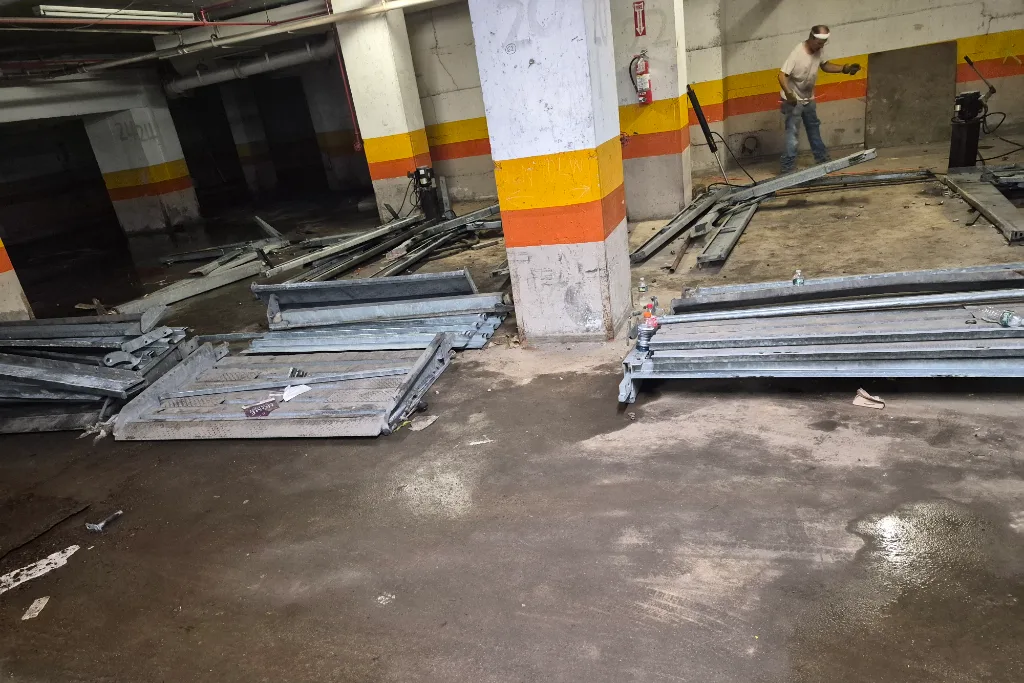
Every piece is carried out and taken away. The bay is swept and washed down, not left as a scrap pile behind a cone.
 One crew. Start to finish.
How We Get It Done
Survey The Bay
We measure headroom, the ramp and the freight elevator, count the systems, and confirm how the pieces get out before we quote. That survey is what the price is built on.
Isolate And Drain
Your electrician isolates the power to the operators. We relieve the hydraulics and drain the rams and lines into containment before a cutting disc touches anything.
Break It Down
Platforms first, then cross members, posts and base plates. Sections are cut to a size two people can carry out, and the route is protected as they go.
Make Good And Re-Stripe
Anchors cut flush and ground, holes patched, deck cleaned, then the recovered bays are laid out and striped as standard stalls.
Heavy Work In A Building That Has To Keep Running
A garage stacker weighs more than it looks and comes apart in a space with no headroom, no crane and neighbours upstairs. The work is planning the route out, then cutting to that plan.
Headroom And The Route
Every piece has to clear the deck above and fit the freight elevator or the ramp. That is what sets how the system gets cut, not what is quickest.
Fluids Before Cutting
Rams and lines are relieved and drained into containment first. Cutting a charged hydraulic line puts oil across a deck you then have to clean.
Anchors, Not Just Steel
Bolts left standing proud are the part that turns a cleared bay into a claim. They come off flush, get ground back and the holes get patched.
Bays Back In Service
The last step is layout and striping, so the space stops being a demolition site and goes back to being stalls.
Your electrician isolates the power. Everything after that is ours.
How To Tell The Stackers Should Come Out
- 01
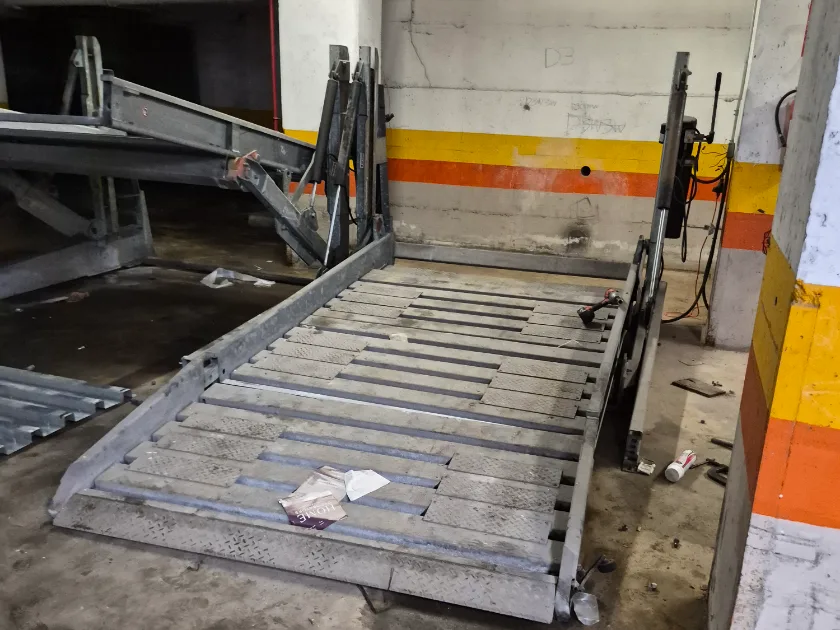
It has been tagged out of service for months
The tag is a decision that has been deferred. Nothing about the cost of holding the system changes while it hangs there, and the bay underneath earns nothing either.
- 02
Nobody can quote a lead time on parts
Plenty of stacker makes are no longer supported in this market. Once a control board or a ram is a salvage-yard item, the repair path has ended whether or not anyone has said so.
- 03
Attendants only use the lower deck
If the people who park the garage every day have quietly stopped using the top platform, you are already running the footprint as ordinary stalls while paying for a lift.
- 04
Fluid marking the slab under the ram
A weeping cylinder stains the deck and puts oil where cars and people are. It is also the failure that tends to end the argument about whether the system is coming out.
What drives the price
The number is driven by how the pieces leave the building, not by the weight of steel. A garage with headroom, a ramp a crew can carry down and somewhere to stage sections is the cheap case. Low clearance, a freight elevator with a size limit, or a system in a pit means smaller cuts and more trips, and that is where the hours go. After that it is the count of systems, how much anchor cutting and patching the slab needs, and whether the building restricts noisy work to nights and weekends. Scrap value comes off the total rather than paying for the job.
When lift & stacker removal is the wrong answer
If the system still runs and parts are available, removal is the expensive answer and a service contract is the cheap one. The other case is a garage whose stall count only works because of the stackers: taking them out to gain a clean floor can lose more capacity than it gains, and the question to answer first is what those bays actually earn as ordinary stalls. If the building is planning EV charging or a wider re-fit, sequence the removal with it so the slab gets opened once rather than twice.
Parking Lift Removal By City
We run parking lift removal out of the same crews that cover these markets. Which garages we can reach in a week depends on the route we are already running, so call and we will tell you where you sit in it.
New Jersey
Across the northern freight corridor: Newark, Jersey City, Elizabeth, Paterson and Clifton.
Across the central logistics belt: Edison and Woodbridge.
Across the shore and Mercer County: Toms River, Hamilton and Trenton.
We also cover New York City and Long Island and Eastern Pennsylvania. Call (917) 829-0403 and we will tell you whether your property sits on a route we already run.
Lift & Stacker Removal FAQ
Do you have to close the garage to take the lifts out?
Usually not. We work bay by bay behind cones and tape, and we schedule the noisy cutting for nights or weekends where the building needs it. What we do need is a route out and somewhere to stage the steel while it is carried.
What happens to the steel and the hydraulic fluid?
Both leave with us. The steel is carried out and hauled away, and the hydraulic oil is drained into containment first and taken off site rather than tipped into a garage drain.
What is left in the bay when you are finished?
A flat, swept floor. Base plates come off, anchor bolts are cut flush and ground back, the holes are patched, and the bays are re-striped as standard stalls so they can be rented the same week.
Can you take out one system rather than all of them?
Yes. Plenty of garages pull the systems that have failed and keep the ones still under service. We price per system and work through them in whatever order suits your occupancy.
Do you take out puzzle and semi-automatic systems as well as two-post stackers?
Yes. Dependent two-post and four-post stackers, puzzle systems and pit-mounted platforms. The survey is what tells us how a particular system comes apart and how the pieces get out of your garage.
What areas do you cover?
New Jersey, the NYC metro, Long Island and Eastern Pennsylvania, under one point of contact and one invoice.
Get Your Lift & Stacker Removal Quote
Free on-site assessment and an itemized quote for any commercial property in the Northeast. Built around your schedule.
Itemized quote within 48 hours · No obligation